Cross-sport recovery timelines: how layoff lengths shift performance baselines in soccer squads, thoroughbred fields, and tennis circuits
Willa Ludwig · Sep 21, 2026
Cross-sport recovery timelines: how layoff lengths shift performance baselines in soccer squads, thoroughbred fields, and tennis circuits
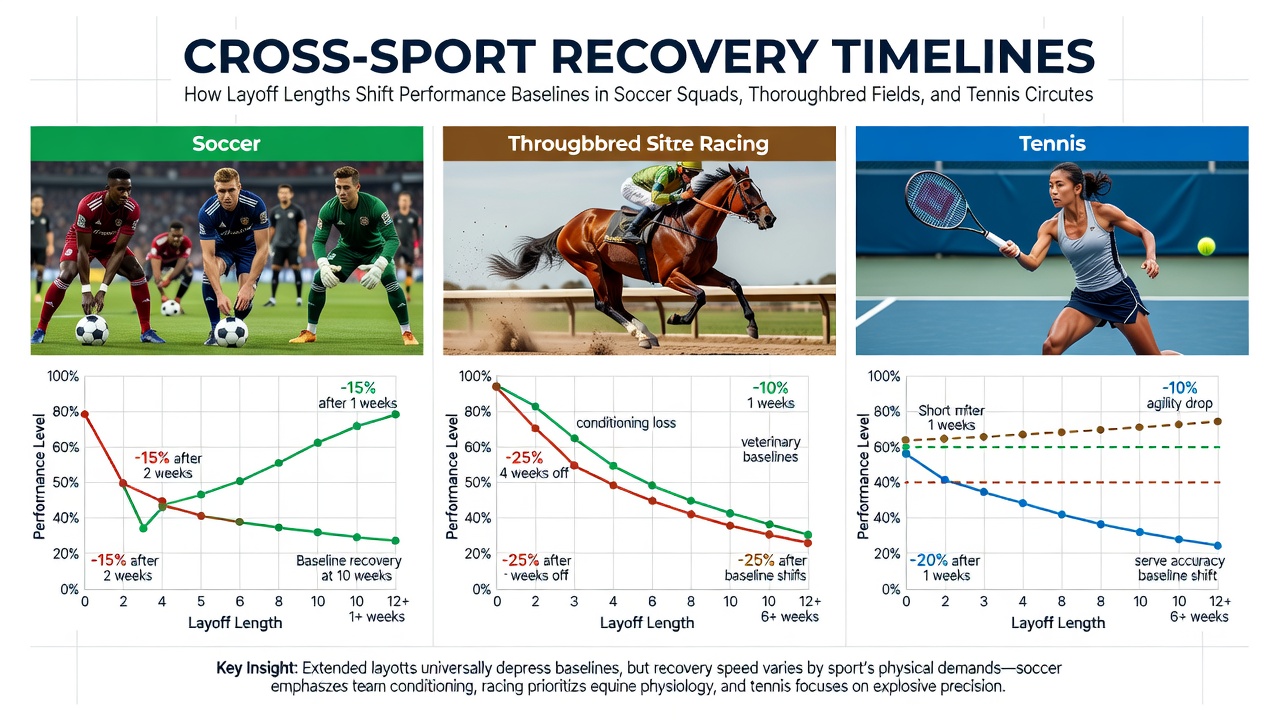
Performance data collected across multiple seasons reveals that layoff durations alter baseline output in measurable ways, and analysts continue to map these shifts in soccer squads, thoroughbred racing fields, and professional tennis circuits. Teams and trainers adjust preparation protocols based on documented return patterns rather than assumptions, while statistical models track metrics such as distance covered, sprint frequency, and win rates after varying rest intervals. As of September 2026, updated datasets from European and Australian competitions show consistent trends that link specific layoff windows to subsequent performance levels.
Soccer squad patterns after enforced breaks
League records indicate that soccer players returning after four to six weeks away from match play often exhibit reduced high-intensity running in their first three appearances, although passing accuracy tends to stabilize faster once tactical familiarity returns. Midfielders and full-backs display the clearest dips in total distance covered when layoffs extend beyond eight weeks, according to aggregated figures released by the European Sports Science Institute. Shorter absences of two to three weeks produce smaller adjustments, and teams that schedule progressive training loads during these periods report quicker restoration of pre-layoff metrics. Data from the 2025-2026 campaign further shows that forwards maintain shot conversion rates closer to baseline when they resume within seven days, whereas longer gaps correlate with a temporary decline that typically corrects after four to five matches.
Thoroughbred recovery windows on the track
Thoroughbred performance after layoffs follows distinct curves that depend on both duration and the horse's age and prior workload. Records compiled by Racing Australia demonstrate that sprinters returning after 30 to 45 days produce peak finishing times more frequently than those rested longer than 90 days, although stayers show improved endurance when given 60 to 75 days away from competition. Trainers note that horses aged five and older require additional conditioning gallops after breaks exceeding 120 days to reach prior speed figures, and these adjustments appear in sectional data released after each meeting. Shorter layoffs under three weeks sometimes yield sharper early-section times, yet the same animals often record lower overall win percentages if the preceding campaign included heavy racing schedules. September 2026 entries highlight several cases where 45-day breaks preceded improved ratings in middle-distance events, while longer rests aligned with modest declines until the third or fourth start post-layoff.
Tennis circuit return timelines
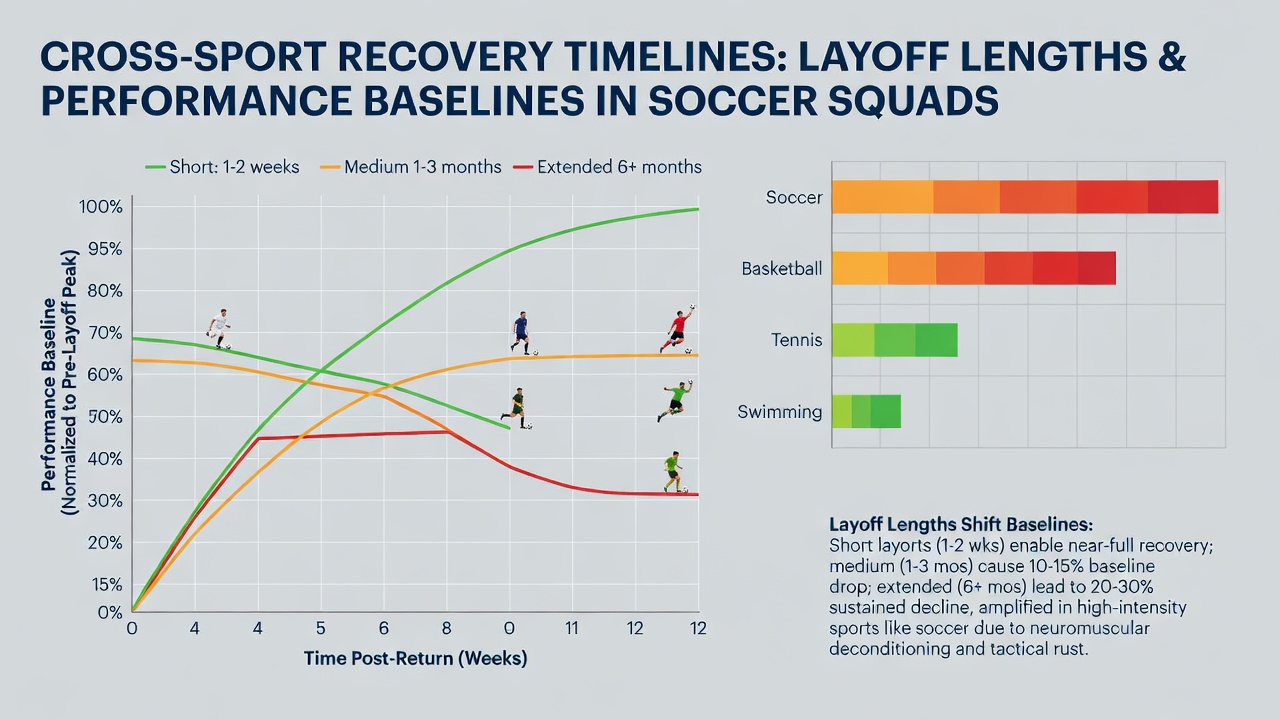
ATP and WTA ranking data illustrate that players resuming after four to eight weeks away maintain serve percentages near career norms more reliably than those sidelined for three months or longer. Baseline rallies and return points won show measurable drops when layoffs stretch past ten weeks, although the effect appears less pronounced on faster surfaces where point construction relies less on sustained movement. Observers tracking 2026 hard-court swings report that players who incorporate on-court movement drills during shorter breaks regain first-serve win rates within two tournaments, whereas extended absences require three to four events before metrics stabilize. Younger competitors under age 24 display faster recovery of ranking points after 30-day layoffs compared with veterans, whose movement efficiency metrics take additional weeks to align with pre-injury levels.
Comparative effects across the three domains
Cross-referenced studies place the optimal recovery window for soccer players between three and five weeks for most positional groups, while thoroughbreds achieve stronger post-layoff results after 30 to 60 days depending on distance specialty. Tennis players show the narrowest performance variance after breaks of two to four weeks, yet longer gaps produce comparable declines to those seen in the other two sports once rest exceeds twelve weeks. Analysts compiling these figures note that surface type, age cohort, and prior workload intensity modify the exact thresholds, and federations continue to release updated guidelines each season to reflect the latest tracking outputs. A 2025 report issued by the Australian Institute of Sport examined parallel datasets and confirmed that structured reintroduction programs shorten the period required to regain baseline performance across all three activities.
Conclusion
Performance baselines shift in predictable patterns once layoff lengths are measured against sport-specific benchmarks, and the evidence accumulated through September 2026 underscores the value of tailored return protocols. Soccer squads, thoroughbred connections, and tennis circuits each operate within distinct recovery envelopes that data now quantifies with increasing precision, allowing preparation teams to align training loads with observed timelines rather than generalized assumptions. Continued collection of granular metrics promises further refinement of these models in subsequent seasons.